
How it works and how much it costs to sell with Amazon FBA
>-
What is Amazon FBA?
Amazon FBA is the fulfillment service offered by the world-famous online sales platform. The acronym stands for Fulfillment by Amazon, indicating that Amazon itself handles warehouse management, inventory monitoring, shipping, customer service, and all related services.
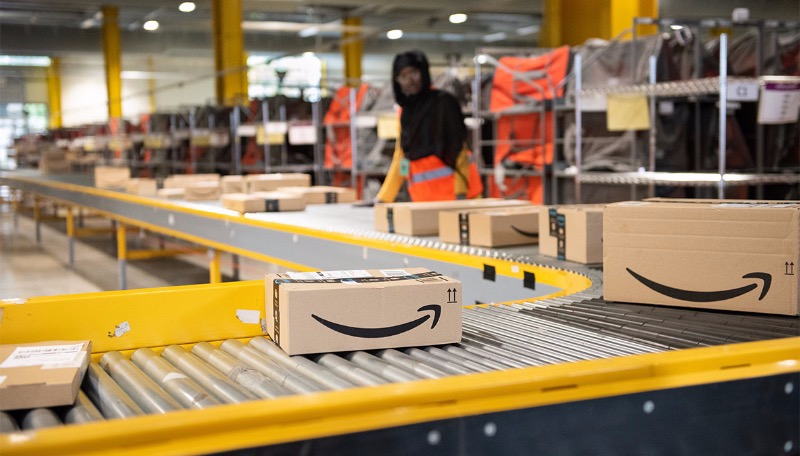
It is an alternative to what is commonly known as Amazon FBM (Fulfillment by Merchant), which is when logistics and shipping are entirely managed by the seller (or partners of their choice).
The service has been available in Italy for several years and has simplified life for many sellers. Those who join the program can take advantage of goods storage in an Amazon warehouse and shipping by the latter to the end customers.
The warehouses receive orders made through the platform directly and handle the packaging and shipping of the goods.
WANT TO KNOW THE COSTS OF SELLING ON AMAZON IN DETAIL?
Amastar · Amazon Agency
Discover how we can help you integrate Amazon into your business
Book a free consultation with our team.
The seller therefore does not have to worry about renting a building, managing orders, packaging products, or shipping, nor about returns or complaints. Amazon will handle everything.
At this point, you might wonder how much the Amazon warehouse and the FBA program cost, likely fearing exorbitant figures given such a high number of services. You might be pleasantly surprised.
Subscribe to our YouTube channel to stay updated!
How much does Amazon FBA cost?
Contrary to what one might expect, Amazon logistics costs are extremely competitive. First, a distinction must be made between:
-
Fulfillment fee;
-
Storage fee;
-
Preparation fees.
Processing (or preparation) fees for packages are optional, as the seller can decide to personally handle the necessary processing and labeling.
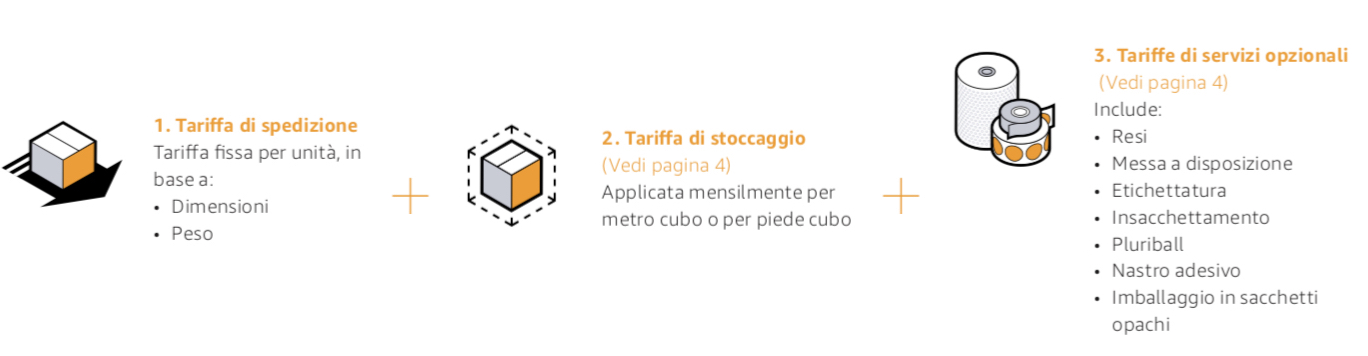
As for the first two items, they depend on:
-
Time of year (with a peak between October and December);
-
Product size and weight;
-
Destination, whether the package is shipped to an Italian address or abroad.
Note: By product size, we do not just mean the item itself, but the packaging it is shipped in.
Based on this consideration, Amazon divides items into three classes:
-
Small and Light, now closed (or at least modified), which we dedicated this article to;
-
Standard size;
-
Oversize.
While the Small and Light program referred to light, low-volume products priced under €10, items are considered oversize when they exceed 45 x 35 x 20 cm and/or weigh more than 9 kg.
All others are categorized as standard size products.
As mentioned, the Small and Light program no longer exists. However, Amazon still provides discounted fulfillment fees for products with similar characteristics.
Based on the weight and volume of your product, Amazon will assign a fulfillment fee that includes shipping from its warehouses to the end customer.
The price is usually between €3 and €5, but you can consult the complete list at this link.
Amastar · Amazon Agency
Discover how we can help you integrate Amazon into your business
Book a free consultation with our team.

Furthermore, with Amazon logistics, it is possible to sell on Amazon across Europe using a single inventory and exporting your catalog to foreign marketplaces. If possible, the rates for this service are even more competitive than those of traditional couriers, as Amazon usually applies a surcharge of €2/€3 compared to a shipment made within Italian territory.
Regarding storage fees, the cost is generally between €25 and €30 per month per cubic meter, but here too we recommend consulting the specific table.
Note: The volume of stored goods is calculated on the average monthly stock.
Special mention should go to long-term storage fees. These are applied by the marketplace to all items in stock for more than 365 days. These additional costs can be around €170 per month per cubic meter or 10 cents per unit, significantly impacting your margins. For this reason, it is necessary to constantly monitor your inventory levels, eventually removing excess units.
Long-term fees were primarily designed to discourage excessive sending of units to fulfillment centers and prevent, as far as possible, their saturation. To the same end, Amazon introduced a real Inventory Performance Index (IPI), based on which sellers are authorized to send more or fewer goods.
The marketplace's goal is to encourage sellers as much as possible to use Amazon FBA. This is also why it has introduced a series of incentives, such as the one we will discuss in the next paragraph.
Amastar · Amazon Agency
Discover how we can help you integrate Amazon into your business
Book a free consultation with our team.
Other advantages of Amazon FBA
As we have seen, Amazon FBA can be truly advantageous. Besides enjoying extremely competitive rates, it has efficiency and reliability that are practically unbeatable. These guarantees are strongly perceived by platform users, who tend to favor purchasing products with the Prime logo. As we saw in the article dedicated to optimizing product listings for smartphones, users who buy via the app are even more likely to select only items with the logo, as the Prime filter is highlighted more prominently.
Furthermore, enrollment in Amazon Prime brings further advantages in terms of ranking. In fact, the Amazon algorithm will tend to reward items managed by Amazon FBA, as they are more reliable for customers.
Using Amazon Prime will also considerably increase your chances of winning the Buy Box.
Main disadvantages of FBA
Amazon FBA presents a wide range of advantages, especially in terms of cost and efficiency, which are very difficult to achieve by managing logistics independently. The reason is simple: Amazon handles millions of shipments every day and has a bargaining power with major logistics providers that is effectively unrivaled.
However, like anything, FBA has some limits and disadvantages.
We have already mentioned how long-term storage fees can represent a very high cost if you do not carefully monitor your inventory turnover.
Another disadvantage can be the preparation that the marketplace requires for all incoming goods. Amazon can be particularly stringent with items containing liquids, batteries, or hazardous materials. Besides requiring certain authorizations from the marketplace, fees for these types of products can be higher than those for standard products. In most cases, independent shipping would be faster and simpler.
Another disadvantage is represented by labeling products. In fact, every incoming item must have a barcode to be recognized and stored correctly. However, many sellers do not have a barcode on their product packaging or, for some reason, indicate one different from the one actually present. In this case, FBM logistics might be more advantageous.
A further limit is represented by very bulky or heavy goods which, for practical reasons, cannot be managed directly by Amazon.

The final disadvantage is the absence of quantity discounts. That is, every item shipped with Amazon logistics is assigned a shipping cost, regardless of whether the same customer buys one or more units. By managing logistics independently and with the same margin on a single item's shipment, it is evident that the seller would find a significant benefit, in almost all cases, in sending multiple units in a single shipment.
Amastar · Amazon Agency
Discover how we can help you integrate Amazon into your business
Book a free consultation with our team.
Conclusions
Amazon FBA is the famous logistics management program offered by the e-commerce giant. It offers numerous advantages in terms of cost and efficiency. From a marketing perspective, FBA allows for benefits in terms of product visibility, as well as displaying the Prime logo on listings managed by Amazon FBA. However, it can also present some disadvantages, and it is wise to evaluate its use carefully. Having already assisted dozens of sellers with Amazon FBA enrollment and management, we are at your complete disposal for any information not found in this article.
Amastar · Amazon Agency
Discover how we can help you integrate Amazon into your business
Book a free consultation with our team.
Frequently Asked Questions:
How does Amazon logistics (Amazon FBA) work?
Amazon FBA is the Amazon logistics program made available to Sellers by the marketplace. Using it is not complex; you just send a stock of products to Amazon logistics, which will store and ship individual units to customers who place an order.
Does the FBA program contribute to increasing sales on Amazon?
Generally, yes. Products managed with Amazon FBA will earn the Prime logo, which is a decisive factor in purchase decisions for many customers. Additionally, products managed with FBA enjoy benefits in terms of organic ranking and the Buy Box.
How much does Amazon logistics cost?
Amazon logistics involves mapping storage fees (around €20-30 per month per cubic meter) and a fulfillment fee. The fulfillment cost can vary greatly based on the weight and volume of the product. Furthermore, there are different rates for national and international shipments.
Is it necessary to use an agency to manage Amazon FBA?
To set up shipments to Amazon logistics, it is not strictly necessary to use a specialized Amazon agency. However, managing the Seller Central account is quite complex, and for greater effectiveness, it is advisable to rely on professionals in the field.
You might also like
Amazon Reviews: why they are important and how to increase them
Small & Light Amazon: what it is and how it works
Amazon SEO: come arrivare in prima pagina su Amazon e posizionarsi
Il primo passo per aumentare le vendite su Amazon è quello di lavorare sulla SEO. Scopri i nostri trucchi e i suggerimenti